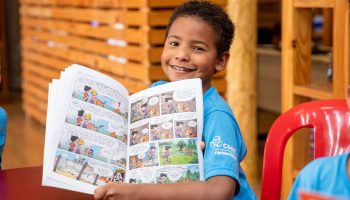
With practical classes, robot programming and STEAM methodology, the Educational Robotics course prepares young people for the challenges of the digital economy and the job market.
The advancement of technology is transforming the world at an ever-increasing speed. Professions related to automation, programming, artificial intelligence and innovation are gaining prominence in the market, increasing the demand for training that develops these skills from an early age. The Educational Robotics course, for example, emerges as an excellent opportunity for those who want to learn in a practical way and acquire skills valued by companies.
But, more than teaching how to assemble machines, educational robotics uses technology as a learning tool. Being a unique combination of learning, innovation, and personal development. In addition to sparking interest in technology, it prepares young people for an increasingly digital and competitive market.
This is because students develop logical reasoning, creativity, teamwork, and problem-solving skills, fundamental competencies for the 21st century. By participating in the course, students learn to transform ideas into concrete projects, develop autonomy, and acquire knowledge that can open doors to various professional areas.
In this way, the course provides a dynamic and engaging experience, allowing young people to come into contact with concepts of mechanics, electronics, and programming while building their own projects.
Although the educational robotics course is not a vocational course, it helps young people develop important skills for the job market by using robot assembly and programming as a teaching methodology. Thus, through practical activities, students learn technology and innovation concepts in an accessible and fun way.
The proposal follows the so-called maker culture, based on the idea of learning by doing. Instead of simply absorbing theoretical content, participants build real solutions to challenges presented during classes.
But it’s not just lessons about technology. During the course, participants develop skills that will be useful both in academic life and in their professional careers. Among the main skills worked on are, for example:
These skills are highly valued in various sectors of the economy and make a difference in selection processes and future opportunities.
The job market is undergoing profound transformations driven by digitalization and automation. Companies in different segments are looking for professionals capable of dealing with technology and solving complex problems.
Educational robotics contributes to this preparation by developing both technical and behavioral skills from an early age.
In addition to so-called hard skills, such as programming and automation, students strengthen behavioral competencies that are increasingly demanded by organizations, such as collaboration, resilience, leadership, and communication.
Even for those who have not yet decided which profession to pursue, contact with robotics broadens career possibilities and helps to better understand the demands of the future.
In addition, one of the great differentiators of educational robotics is the application of the STEAM methodology, an acronym for Science, Technology, Engineering, Arts, and Mathematics. This approach integrates different areas of knowledge to stimulate more complete learning connected to the challenges of the real world. When developing robotics projects, students use mathematical concepts, scientific principles, creativity, and technological knowledge simultaneously.
Therefore, young people who have contact with robotics tend to find it easier to pursue careers related to engineering, computer science, information technology, industrial automation, and software development.
Ramacrisna Institute offers its Educational Robotics course completely free of charge. In the classes, students explore the world of technology using LEGO Mindstorms, one of the most comprehensive educational kits currently available. With it, they can build robots capable of performing tasks, responding to commands, and interacting with their environment.
The activities are based on challenges inspired by real-life situations, encouraging creativity and the search for innovative solutions. Each project developed helps strengthen knowledge in logic, mechanics, automation, and programming.
The course is held in person, with classes twice a week in the morning. To enroll, students must be at least 14 years old and currently attending elementary school. The program consists of 110 class hours, with 20 students per group.
If you are looking for a modern, hands-on education aligned with the demands of the future, Ramacrisna’s Educational Robotics course can be the first step toward a journey full of opportunities.
Want to learn more about enrollment? Follow Ramacrisna’s channels and find out how to become part of this innovative experience.