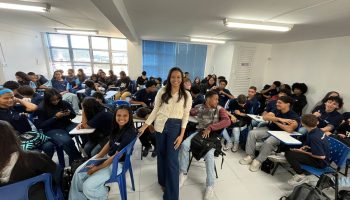
The date promotes reflection on the global challenges of gender equality. It is everyone’s commitment to offer opportunities, autonomy, and justice for girls and women
Despite being a goal for 2030, we are still far from achieving gender equality. According to the United Nations (UN), in 2026 women will have only 64% of the legal rights that men have worldwide. Furthermore, no country has completely eliminated legal gaps.
In fundamental areas of life, such as work, income, security, family, property, mobility, business, and retirement, the law still puts women at a disadvantage. Between harmful social norms, discriminatory laws, and structural barriers, women and girls continue to face deeply rooted obstacles. If progress continues at the current pace, it will take 286 years to eliminate the gaps in legal protection.
International Women’s Day 2026, with the theme “Rights. Justice. Action. For ALL women and girls,” reinforces the urgency of dismantling structural barriers, combating discriminatory laws, and strengthening inclusive justice systems.
The Federal Constitution of 1988 establishes gender equality as a fundamental principle, declaring in Article 5, item I, that men and women are equal in rights and obligations. In other words, the law prohibits discrimination, guarantees protection for maternity/work, and ensures equality in the family, marking a milestone in overcoming historical inequality.
But practice differs from theory. Society needs to guarantee access to education for girls, an end to child marriage, and freedom for women to work, lead, and participate in political and social life, for example.
In addition, effective protection against all forms of gender-based violence needs to move beyond theory. So do unbiased justice systems, accessible legal aid, and non-discriminatory public policies.
To try to achieve all this, the UN established, in its Sustainable Development Goal 5 (SDG 5), the target of “Achieving gender equality and empowering all women and girls” by 2030. This goal must be shared by everyone: companies, governments, and the third sector.
The Ramacrisna Institute reaffirms its commitment to gender equality on a daily basis, in line with the UN’s Sustainable Development Goal 5 (SDG 5), especially item 5.b, which calls for increased use of basic technologies, particularly information and communication technologies, to promote women’s empowerment. There are several projects aligned with the SDGs, such as:
Girls in Network is one of the initiatives most directly connected to the promotion of gender equality. The project encourages teenagers to enter the STEM (Science, Technology, Engineering, and Mathematics) universe, areas historically marked by low female participation.
In the Website and Application Development course, students learn to develop applications, create interactive interfaces, structure databases, and understand the user experience. More than technical skills, the project promotes self-confidence, leadership, and contact with female role models in technology. At the end, each participant develops a mobile application, putting their acquired knowledge into practice and broadening their future prospects.
FabLab Ramacrisna promotes technological inclusion and innovation. The space offers access to digital manufacturing tools, such as 3D printers and prototyping equipment, allowing girls and women to develop creative projects, products, and solutions. By democratizing access to technology, FabLab contributes to reducing inequalities and stimulating female entrepreneurship.
The Ramacrisna Orchestra uses music as a tool for social inclusion. By ensuring that girls have access to musical training, public performances, and artistic development, the project strengthens self-esteem, discipline, and teamwork. The presence of women in classical and instrumental music also helps to break gender stereotypes and expand opportunities for cultural leadership.
CAER (Ramacrisna Educational Support Center) offers tutoring and educational support, ensuring that girls stay in school and have better academic opportunities. In addition, they have access to a range of sports and cultural activities, which contribute to their cognitive, physical, emotional, and social development. Access to these practices in childhood promotes the comprehensive development of each of these girls.
Promoting gender equality means ensuring access to education, technology, culture, and decent work. At Ramacrisna, each project is a concrete action to give girls and women more opportunities, autonomy, and a voice.
Because equality cannot wait centuries. It starts now with education, opportunities, and action.
Help keep up the fight for gender equality. Contact us and find out how you can help.