Children|Education / Professionalization|ESG|Technology and inovation
Building more equitable relationships begins in the early years of life and must include boys in the conversation about respect, opportunities, and rights
Talking about gender equity in childhood means talking about the future. After all, many of the ideas children develop regarding boys and girls—whether they are positive or negative—begin to take shape in the very first years of life. Therefore, promoting equality between men and women requires an education that involves everyone.
When the debate on gender focuses solely on girls, an important opportunity to transform relationships is lost. Boys also need to learn, from an early age, that men and women have the same rights and should have access to the same opportunities. More than that: they need to understand the importance of mutual respect.
Throughout childhood, children may receive different messages about how they should behave. Girls are often encouraged to be gentle and careful, while boys may hear more frequently that they need to be strong, not show emotions, or avoid certain games and activities.
These stereotypes limit everyone’s development. Gender equity in childhood helps create environments where every child is free to discover their interests, develop skills, and express feelings.
Involving boys in this process means discussing respect and equality in ways appropriate for each age group—whether through dialogue, play, positive examples, or a balanced division of responsibilities.
It is also important to teach that taking care of the home, expressing emotions, respecting boundaries, and combating prejudiced behavior are not exclusively female responsibilities. These are necessary behaviors for healthy coexistence.
This debate is also directly related to the United Nations (UN) 2030 Agenda. Sustainable Development Goal (SDG) 5 aims to achieve gender equality and promote the empowerment of all women and girls.
But this goal cannot be achieved only once people reach adulthood. The transformation must begin in childhood, when values and ways of relating to others are still being formed.
Education plays an essential role in this process, in conjunction with SDG 4, which addresses Quality Education, and SDG 10, on Reducing Inequalities. Creating educational spaces that value diversity and equality helps foster more conscious citizens who are better prepared to build a more just society.
At the Ramacrisna Institute, promoting opportunities for children, adolescents, and young people also contributes to building a more equal society. This work involves both initiatives directly aimed at empowering girls and shared spaces for social interaction and learning.
One example is “Meninas em Rede” (Girls in Network), a project that encourages female participation in a field still dominated by men: technology. Through programming activities and the development of websites and apps, the initiative expands opportunities for girls and women and helps dispel the notion that certain professions or areas of knowledge are reserved solely for men.
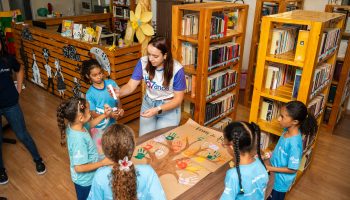
Discussions on gender equity in childhood also take place in spaces such as NAVE Ramacrisna (Center for Essential Learning and Experiences), which offers learning and social experiences for children and adolescents. In everyday life, these spaces provide opportunities to foster respect for differences, cooperation, and the fight against stereotypes that can limit both girls and boys.
At the same time, it is important for boys to participate in this process. Promoting gender equality does not mean merely creating opportunities for girls. It also means educating boys to recognize inequalities, respect women, and understand that no activities, professions, or behaviors belong exclusively to one gender.
You, too, can help build a more equitable future. Learn about the Ramacrisna Institute’s projects and be part of this transformation. Find out how you can help ensure that children, teens, and young adults have access to education, opportunities, and experiences that broaden their horizons.