Initiative uses digital technologies to develop research, text interpretation, communication, and content production skills among children and adolescents
In an increasingly connected world, developing digital literacy skills has become essential for the education of children and adolescents. However, digital literacy goes far beyond simply learning how to use technological tools. The challenge lies in knowing how to research, interpret information, create content, and communicate in a conscious and critical way. With this goal in mind, NAVE Ramacrisna (Center for Essential Learning and Experiences) — formerly known as CAER — carries out a project that combines technology, education, and student protagonism to strengthen fundamental reading and writing skills.
The Digital Literacy Project was initially developed for students aged 13 to 14 and is part of an ongoing learning initiative. The project seeks to integrate research, writing, and technological resources, encouraging students to take an active role in building their own knowledge.
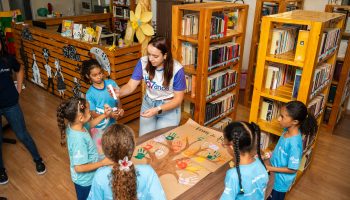
Throughout the activities, participants conduct research using digital sources, select relevant information, write and revise texts, choose topics of interest, and create presentations using tools such as Canva. At the end of each stage, students present their work to their peers, further strengthening communication, public speaking, and organizational skills.
The concept of digital literacy goes beyond simply having access to technology. It involves the ability to understand, analyze, and create content in digital environments while using available tools critically and responsibly.
Through the project, students learn how to research, compare sources, organize information, and transform knowledge into presentations and digital materials. The entire process is supported by educational guidance focused on developing reading, writing, and text interpretation skills.
The project’s methodology is based on active learning, an educational model that places students at the center of the learning process. Instead of merely receiving information, participants learn how to investigate topics, build knowledge, and share their discoveries with classmates.
This approach helps strengthen skills that are increasingly valued both inside and outside the classroom, such as critical thinking, creativity, autonomy, communication, and problem-solving.
The project also contributes to students’ performance in other workshops offered by the institution. The idea emerged after identifying significant challenges faced by students in areas such as reading, writing, information interpretation, and communication, which were impacting various activities. This led instructors from different fields to work together in developing a joint solution.
As a result, the Digital Literacy Project helps students better understand proposed activities, produce more complete records and assignments, and participate more actively in learning processes.
The initiative also promotes integration across different areas of knowledge. Skills developed through research and content creation activities can be applied in technology, robotics, programming, and sports workshops, among others.
The Digital Literacy Project is aligned with the mission of NAVE Ramacrisna. The initiative represents a new phase of a program that has existed for more than 30 years and was previously known as the Ramacrisna Educational Support Center (CAER).
The change in identity reflects a broader understanding of the learning process. The development of children and adolescents occurs through diverse experiences. It is shaped by human relationships, opportunities, and experiences that go beyond the boundaries of the traditional classroom.
Designed for public school students aged 6 to 15, NAVE offers free activities that integrate education, culture, sports, technology, and social interaction. The goal is to broaden horizons, foster potential, and contribute to the holistic development of participants.
In this context, digital literacy emerges as an essential tool for preparing young people for the challenges of both the present and the future. In an increasingly connected society, the ability to interpret information, communicate ideas, and use technology responsibly is just as important as mastering traditional academic subjects.
Help transform the lives of more children and adolescents. Get in touch and learn how you can support this mission.