School dropout is a violation of the right to education. Learn how the Statute of the Child and Adolescent provides guidance on addressing this problem
School dropout remains one of the main challenges facing Brazilian education. When a child or adolescent stops attending school, they lose not only access to learning but also opportunities for development, social protection, and building a future with more possibilities. Therefore, combating school dropout is a shared responsibility among families, schools, government, and civil society organizations.
The Statute of the Child and Adolescent (ECA), which marks its 36th anniversary this Monday (July 13), recognizes education as a fundamental right and establishes duties for various actors in the protection network to prevent students from dropping out of school.
In recent years, Brazil has made significant progress in addressing school dropout. According to the 2025 School Census, between 2022 and 2025, the dropout rate in public high schools fell by 61%. During the same period, there was a 62% reduction in failure rates, an 11% increase in the pass rate, and a 28% decrease in age-grade mismatch.
These results show that a greater number of young people have managed to stay in school and advance in their educational journey. Another positive indicator was the 46% increase in registrations for the National High School Exam (Enem) since 2022. This increase suggests that more students are completing basic education and planning to continue their studies.
However, despite these advances, thousands of children and adolescents still face obstacles to staying in school, which underscores the importance of integrated actions among the government, schools, and civil society.
According to the Statute of the Child and Adolescent (ECA), every child and adolescent has the right to education, aimed at full development, preparation for the exercise of citizenship, and qualification for work. Therefore, when a student is frequently absent or stops attending school, the ECA establishes a protocol to prevent this absence from becoming permanent dropout. The goal is not to punish the student or their family, but to ensure that the right to education is upheld.
According to the ECA, the school must exhaust all possibilities for keeping the student in the classroom before reporting the case to the Child Protection Council. This means that the educational institution must take measures such as:
Only after attempting all these strategies should the school refer the situation to the Child Protection Council.
Upon receiving the notification, the Child Protection Council begins investigating the causes of school dropout and activates the protection network to ensure that the child or adolescent returns to school. Depending on the situation, social assistance services—such as the Social Assistance Reference Centers (CRAS)—may be involved, in addition to other public policies aimed at supporting families.
Furthermore, the ECA also establishes responsibilities for parents and guardians. When they fail, without justification, to enroll or keep their children in school, they may be held liable for an administrative violation, as established in Article 249 of the Statute.
Public authorities, for their part, have a duty to develop programs that encourage students to remain in school and promote the reintegration of those who have interrupted their educational path.
Third-sector organizations play a role that complements public education policies. Although they do not replace the role of schools or the government, they help create conditions that enable children and adolescents to stay in school. Social projects offer safe spaces, as well as cultural, sports, and vocational training activities that strengthen young people’s connection to learning and broaden their future prospects.
In addition, many institutions work closely with families, providing social monitoring, guidance, and support to address situations that can contribute to school dropout, such as economic vulnerability, learning difficulties, or family conflicts. These efforts strengthen the safety net provided for by the ECA and help reduce risk factors that drive children and adolescents away from school.
At the Ramacrisna Institute, education is the primary tool for social transformation. For more than six decades, the institution has been developing projects that expand access to knowledge, strengthen family and community ties, and create opportunities for children, adolescents, and young people to continue their education and build a life plan.
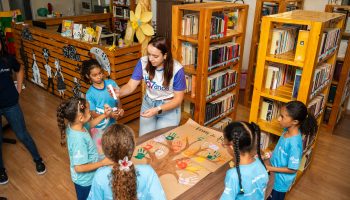
One of the highlights is NAVE Ramacrisna (Center for Essential Learning and Experiences). The program serves children and adolescents after school, offering socio-educational activities that complement what they learn in regular school. In addition to reinforcing cognitive skills, participants develop social-emotional competencies and take part in workshops on art, culture, sports, technology, and reading promotion, strengthening their connection to education from the earliest years of their development.
Another important tool for combating school dropout is the Ramacrisna Apprentice Program. Under the Apprenticeship Law, participants must be enrolled in and attending school to join and remain in the program. In this way, the initiative creates a direct incentive to continue their studies, while also offering theoretical training, professional experience, and support throughout the learning process.
To continue helping the country change the reality of school dropout, please make a donation. Visit our website and choose the best way to contribute.