Memory, focus, emotional intelligence, and social interaction are among the benefits provided by music. At Ramacrisna, music education also paves the way for the inclusion and development of young people
Classical music doesn’t have to be a distant world, reserved for concert halls or people with in-depth knowledge of music theory. Beyond its artistic and cultural value, it can stimulate different brain functions, contribute to emotional balance, and support the development of children and young people. The benefits of classical music for the brain range from concentration and memory to emotional perception and the ability to work in a group.
These effects help explain why music education is also an important tool in education. By learning an instrument, following a score, or participating in a group performance, students exercise skills that extend beyond the artistic realm.
Exposure to classical music stimulates different areas of the brain related to memory, attention, reasoning, and the processing of emotions. Musical practice, especially when it involves learning to play an instrument, requires motor coordination, auditory perception, discipline, and concentration, for example.
Among the main benefits are:
But the effects aren’t limited to those who play an instrument. Listening to music can also provide moments of relaxation, stimulate the imagination, and broaden one’s cultural repertoire.
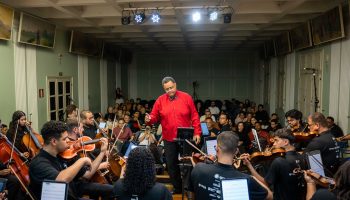
In an orchestra, learning takes place both individually and collectively. Each musician must master their instrument, but also learn to listen to the others, respect the group’s tempo, and follow the conductor’s directions.
In other words, this dynamic fosters skills such as discipline, cooperation, responsibility, and respect. The performance of a composition depends on everyone’s participation, which makes music a concrete experience of social interaction and teamwork.
When this learning reaches children and young people who have less access to cultural activities, music education can also represent an opportunity for social inclusion, broadening horizons, and discovering new professional and personal possibilities.
In 2005, the Ramacrisna Institute founded the Ramacrisna Youth Orchestra, which later became the Ramacrisna Philharmonic Orchestra. The project was created to introduce children and young people to the world of classical music, offering artistic training to socially vulnerable individuals.
Currently, 50 musicians, aged 9 to 29, participate in classes on music theory and instrumental practice, covering string, wind, and percussion instruments. The program is led by conductor Eliseu Martins de Barros, with the participation of teachers Alexandre Barros, who oversees the wind section, and Elias Barros, who works with the violin students.
Throughout its history, the orchestra has performed at major cultural venues in Greater Belo Horizonte, such as the CCBB, Teatro Bradesco, Cine Theatro Brasil Vallourec, Palácio das Artes, and the PUC Minas Museum of Natural Sciences.
The group has also shared the stage with artists of various genres, including Italian tenors Claudio Mattioli and Massimiliano Barbolini, tenor Felipe Peletta, Saulo Laranjeira, Trio Amaranto, DoContra, the band Tianastácia, and singer Seu Jorge.
More than just training musicians, the Ramacrisna Philharmonic Orchestra demonstrates how access to culture can contribute to human development. By learning music, young people exercise cognitive skills, strengthen bonds, and discover new ways to express their talent. This is how art transcends the stage and becomes an opportunity.
Help ensure that more children and young people have access to music. Learn about the Ramacrisna Institute’s projects and discover how to support this transformation. Visit our website and be part of this chain of goodwill!