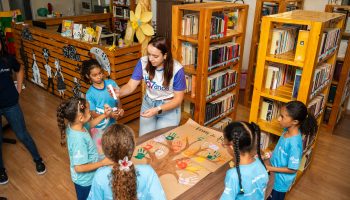
Children and teenagers are participating in a program that brings together literature, creativity, and popular culture through the “Meu Cordel” project
Cordel literature will serve as the starting point for an experience that combines reading, writing, creativity, and an appreciation for popular culture at the Professor Arlindo Corrêa da Silva Library, part of the Ramacrisna Institute in Betim. This Friday (the 14th), the institution will welcome cordel writer Juvenal Bernardes, who will speak with students about the history and characteristics of cordel, introducing concepts such as meter and rhyme schemes.
In a relaxed roundtable discussion, participants will have the opportunity to learn more about the construction of verses and gain a practical understanding of how the elements that characterize cordel literature are used in the creation of texts.
The activity kicks off a series of events that will continue throughout the month. On August 18 and 20, storyteller Nana will lead a creative writing workshop, encouraging students to develop their own ideas and literary works. Then, on August 25 and 27, participants will put the knowledge gained during the project into practice in a woodcut workshop—a technique traditionally associated with the illustration of cordel pamphlets.
For librarian Diná Alves, the initiative contributes to the development of children and adolescents in various areas. “This process is extremely important both for the development of children’s reasoning, reading, and writing skills and for cultural preservation through cordel literature.”
Throughout the activities, participants will engage with different stages of cordel production, from understanding its structure and language to creating texts and images. The initiative aims to introduce children to literature in a playful and participatory way, stimulating creativity and an interest in reading and writing.
The activities are part of the “Meu Cordel” project, carried out by the Ramacrisna Institute in partnership with the City of Betim and sponsored by CEMIG and Essencis. The initiative uses cordel literature and woodcut printing as tools for cultural education and appreciation, providing participants with the opportunity to learn about, experiment with, and create works based on these expressions of Brazilian popular culture.